Free Ski
Overview⚓︎
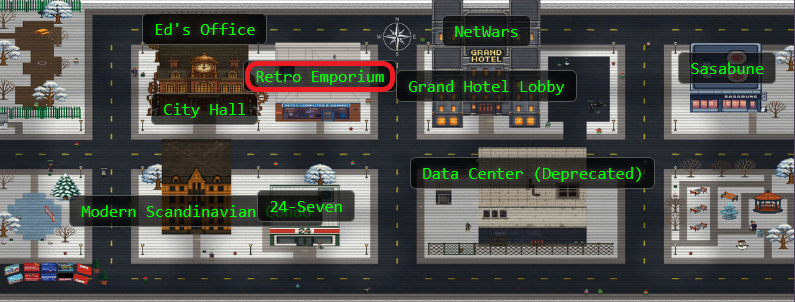
Go to the retro store and help Goose Olivia ski down the mountain and collect all five treasure chests to reveal the hidden flag in this classic SkiFree-inspired challenge.

Olivia
"HONK! Well hello there! Fancy meeting you here in the Dosis Neighborhood.
You know, it's the strangest thing... I used to just waddle around the Geese Islands going 'BONK' all day long. Random noises, no thoughts, just vibes. But then something changed, and now here I am—speaking, thinking, wondering how I even got here!
HONK! You know what happens to geese in a permanent winter? We can't migrate! And trust me, being stuck in one place forever isn't natural—even for someone who just discovered they can think and talk. Frosty needs to chill out... wait, that's exactly the problem!
Olivia
This game looks simple enough, doesn't it? Almost too simple. But between you and me... it seems nearly impossible to win fair and square.
My advice? If you ain't cheatin', you ain't tryin'. wink
Now get out there and show that mountain who's boss!
Hints⚓︎
Extraction
Have you ever used PyInstaller Extractor?
Decompilation!
Many Python decompilers don't understand Python 3.13, but Decompyle++ does!
Solution⚓︎
The Challenge That Giggles at Your Gaming Skills⚓︎
FreeSki is a delightful throwback to the classic SkiFree game from the 90s. You control a tiny skier barreling down an endless snowy mountain, dodging trees and boulders while hunting for 5 treasure chests. Collect all 5 treasures, and the game reveals a hidden flag.
One look at this game and it's immediately obvious: this was designed by someone who clearly never wants anyone to actually win it legitimately. The treasures spawn in what appears to be random locations across a massive mountain, obstacles pop up faster than a yeti on espresso (that's a scary thought), and the collision detection is unforgiving.
Olivia wasn't kidding when she said "if you ain't cheatin', you ain't tryin'." Let's crack open the executable and extract that flag without touching the arrow keys even once (well, I mean we will probably have to touch our arrow keys, but that's beside the point...)
This is reverse engineering after all. Why ski when you can just stay warm and hack?
Unwrapping the Frozen Package⚓︎
Python games distributed as standalone .exe files are usually packaged with PyInstaller. Kind of like a gift wrapper that bundles Python code, the Python interpreter, and all dependencies into a single executable. It's convenient for distribution (users don't need Python installed), but it's also completely reversible!
PyInstaller packages work by:
- Compiling Python source code (
.py) into bytecode (.pyc) - Bundling the bytecode along with a Python interpreter
- Wrapping everything in an executable that unpacks and runs when launched
We can unwrap that gift and peek inside! Eeee, presents!!
The first hint pointed us to PyInstaller Extractor, a Python script that reverses the packaging process:
wget https://raw.githubusercontent.com/extremecoders-re/pyinstxtractor/master/pyinstxtractor.py
python3 pyinstxtractor.py FreeSki.exe
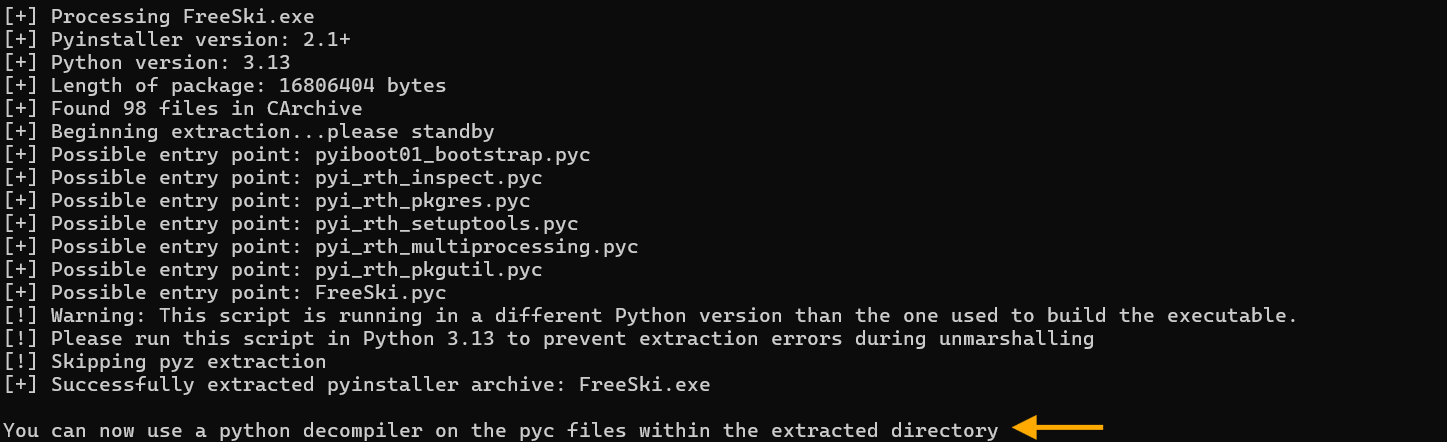
Boom! The extractor dumps everything into a FreeSki.exe_extracted directory. We get:
- FreeSki.pyc: The main game bytecode (this is our target!)
- PYZ.pyz: Archive containing Python standard library modules
- Various
.dllfiles: Windows dependencies (SDL2 for graphics, etc.)
The warning about Python 3.13 is super duper important. PyInstaller Extractor successfully extracts the files but warns us that decompilation might fail because we're running Python 3.12, not 3.13. This matters because Python bytecode format changes between versions, and decompilers can be picky...and this one is really picky.
Most importantly, we now have FreeSki.pyc, the compiled bytecode containing all the game logic, treasure generation, and flag decoding. This is the treasure map!
When Decompilers Get the Sniffles⚓︎
Here's where things get interesting. We have bytecode (.pyc), but what we really want is readable Python source code. Here's the difference:
- Source code: Human-readable Python with variable names, comments, clear logic
- Bytecode: Machine-readable instructions that the Python interpreter executes, looks like gibberish to humans
A typical reverse engineering workflow would be:
- Extract .pyc bytecode (done!)
- Decompile bytecode back to source code (hoping there's no errors!)
- Read the source code and understand the logic (aka, research!)
But here's the catch: Python 3.13 is brand spanking new, and most decompilers haven't caught up yet. Running popular decompilers on FreeSki.pyc produces errors faster than a...insert a whimsical pun with a slow animal
Enter Decompyle++ (pycdc), one of the few decompilers that actually understands Python 3.13 bytecode (but output can be fussy!)
wget https://github.com/zrax/pycdc/archive/refs/heads/master.zip -O pycdc.zip
unzip pycdc.zip
cd pycdc-master
cmake .
make

After compilation finishes, we get two super useful tools:
- pycdc: Attempts to decompile bytecode back to Python source
- pycdas: Disassembles bytecode into human-readable instruction listing
Trying to decompile FreeSki.pyc produces... partial results. Some functions decompile cleanly, others hit unsupported opcodes and bail out. This happens when the bytecode contains instructions the decompiler doesn't fully understand yet.
No problem! When decompilation fails, we can fall back to disassembly.
Reading the Assembly Language of Magical Elves⚓︎
Disassembly is our backup plan, and for reverse engineering, it's often better than decompiled source because you see exactly what the code does without the decompiler making assumptions or educated guesses.
From the pycdc-master directory:
./pycdas ../FreeSki.exe_extracted/FreeSki.pyc > ~/FreeSki_disasm.txt 2>&1
This produces nearly 3000 lines of bytecode disassembly showing every instruction in the game.
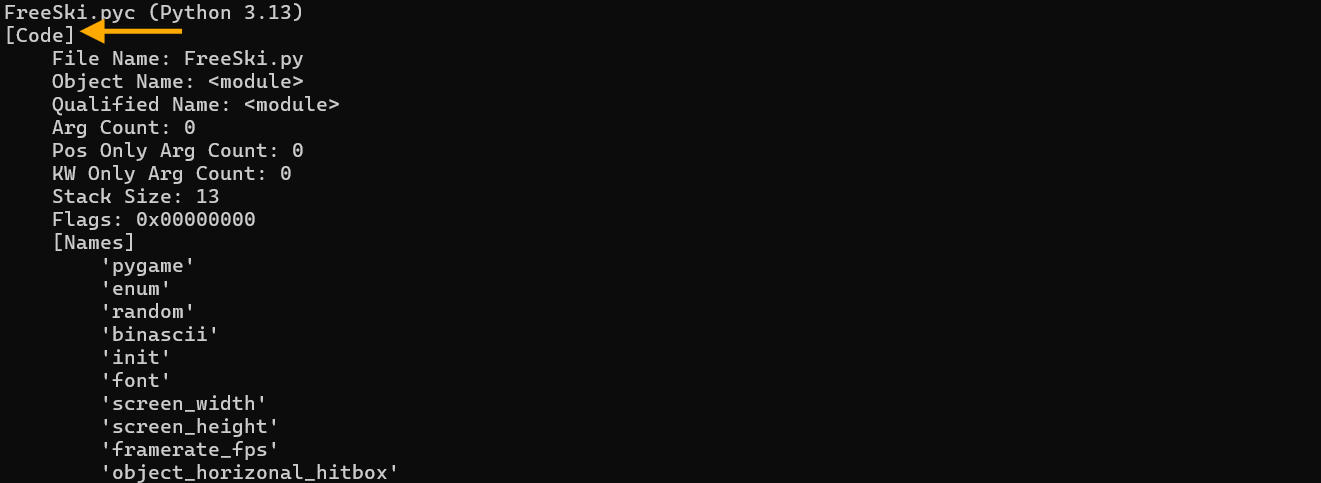
What we get is nearly 3000 lines of Python bytecode instructions. This isn't quite as cozy to read as source code, but it's infinitely more readable than raw hex bytes! Think of it as reading sheet music instead of listening to the symphony: you can still understand what's happening, you just need to interpret the notation.
Each instruction in the disassembly shows:
- Line number: Position in the disassembly (for navigation)
- Instruction name: What operation to perform (
LOAD_FAST,CALL,BINARY_OP, etc.) - Parameters: What the instruction operates on (variable names, constants, memory addresses)
For example, this bytecode:
16      LOAD_FAST                       2: product
18      LOAD_CONST                      2: 8
20      BINARY_OP                       3 (<<)
Translates to Python as:
product << 8
It's loading the variable product onto the stack, loading the constant 8, then performing a binary left shift operation. The result stays on the stack for the next instruction.
At first bytecode looks intimidating, but after you recognize common patterns (load variable, call function, store result), your brain starts auto-translating (or auto-shutdown in my case a few times). The huge advantage here is that variable names are preserved! No more cryptic var_1, var_2 nonsense. We get actual meaningful names like product, treasure_val, and encoded_flag.
The disassembly gives us a complete blueprint of exactly what the game does, step by step. It's wordy but super thorough. Every single operation is visible, which means we can reconstruct the entire algorithm with perfect accuracy. fingers-crossed
Following the Breadcrumb Trail Through the Snow⚓︎
With 3000 lines of bytecode in front of us, we need to search for keywords related to our goal.
We're looking for how the game:
- Generates treasure positions
- Detects when we collect a treasure
- Decodes the flag when we get all 5
Grep is our bestie here:
grep -n "SetFlag\|GetTreasureLocations\|Mountain" ~/FreeSki_disasm.txt | head -30
This quickly reveals the most important functions in the disassembly:
- Mountain.GetTreasureLocations: Generates the 5 treasure positions for a mountain
- SetFlag: Decodes and displays the flag after collecting all treasures
- Main game loop: Handles treasure collection during gameplay
These three pieces form the complete puzzle. Let's start with treasure generation!
Treasure Generation: Deterministic Chaos!⚓︎
First, let's find the treasure generation function in our disassembly:
grep -n "GetTreasureLocations" ~/FreeSki_disasm.txt
This shows us where GetTreasureLocations is located. Let's view that function:
sed -n '1253,1358p' ~/FreeSki_disasm.txt
GetTreasureLocations Bytecode (click to expand)
Object Name: GetTreasureLocations
                Qualified Name: Mountain.GetTreasureLocations
                Arg Count: 1
                Pos Only Arg Count: 0
                KW Only Arg Count: 0
                Stack Size: 8
                Flags: 0x00000003 (CO_OPTIMIZED | CO_NEWLOCALS)
                [Names]
                    'random'
                    'seed'
                    'binascii'
                    'crc32'
                    'name'
                    'encode'
                    'height'
                    'range'
                    'randint'
                    'int'
                [Locals+Names]
                    'self'
                    'locations'
                    'prev_height'
                    'prev_horiz'
                    'i'
                    'e_delta'
                    'h_delta'
                [Constants]
                    None
                    'utf-8'
                    0
                    5
                    200
                    800
                    4
                [Disassembly]
                    0       RESUME                          0
                    2       BUILD_MAP                       0
                    4       STORE_FAST                      1: locations
                    6       LOAD_GLOBAL                     0: random
                    16      LOAD_ATTR                       2: seed
                    36      PUSH_NULL
                    38      LOAD_GLOBAL                     4: binascii
                    48      LOAD_ATTR                       6: crc32
                    68      PUSH_NULL
                    70      LOAD_FAST                       0: self
                    72      LOAD_ATTR                       8: name
                    92      LOAD_ATTR                       11: encode
                    112     LOAD_CONST                      1: 'utf-8'
                    114     CALL                            1
                    122     CALL                            1
                    130     CALL                            1
                    138     POP_TOP
                    140     LOAD_FAST                       0: self
                    142     LOAD_ATTR                       12: height
                    162     STORE_FAST                      2: prev_height
                    164     LOAD_CONST                      2: 0
                    166     STORE_FAST                      3: prev_horiz
                    168     LOAD_GLOBAL                     15: NULL + range
                    178     LOAD_CONST                      2: 0
                    180     LOAD_CONST                      3: 5
                    182     CALL                            2
                    190     GET_ITER
                    192     FOR_ITER                        93 (to 380)
                    196     STORE_FAST                      4: i
                    198     LOAD_GLOBAL                     0: random
                    208     LOAD_ATTR                       16: randint
                    228     PUSH_NULL
                    230     LOAD_CONST                      4: 200
                    232     LOAD_CONST                      5: 800
                    234     CALL                            2
                    242     STORE_FAST                      5: e_delta
                    244     LOAD_GLOBAL                     0: random
                    254     LOAD_ATTR                       16: randint
                    274     PUSH_NULL
                    276     LOAD_GLOBAL                     19: NULL + int
                    286     LOAD_CONST                      2: 0
                    288     LOAD_FAST                       5: e_delta
                    290     LOAD_CONST                      6: 4
                    292     BINARY_OP                       11 (/)
                    296     BINARY_OP                       10 (-)
                    300     CALL                            1
                    308     LOAD_GLOBAL                     19: NULL + int
                    318     LOAD_FAST                       5: e_delta
                    320     LOAD_CONST                      6: 4
                    322     BINARY_OP                       11 (/)
                    326     CALL                            1
                    334     CALL                            2
                    342     STORE_FAST                      6: h_delta
                    344     LOAD_FAST_LOAD_FAST             54: prev_horiz, h_delta
                    346     BINARY_OP                       0 (+)
                    350     LOAD_FAST_LOAD_FAST             18: locations, prev_height
                    352     LOAD_FAST                       5: e_delta
                    354     BINARY_OP                       10 (-)
                    358     STORE_SUBSCR
                    362     LOAD_FAST_LOAD_FAST             37: prev_height, e_delta
                    364     BINARY_OP                       10 (-)
                    368     STORE_FAST                      2: prev_height
                    370     LOAD_FAST_LOAD_FAST             54: prev_horiz, h_delta
                    372     BINARY_OP                       0 (+)
                    376     STORE_FAST                      3: prev_horiz
                    378     JUMP_BACKWARD                   95 (to 190)
                    382     END_FOR
                    384     POP_TOP
                    386     LOAD_FAST                       1: locations
                    388     RETURN_VALUE
                [Exception Table]
At first glance, this looks complicated, but let's walk through it step by step by looking at the bytecode instructions:
Instructions 6-138: Seed the random number generator
The code loads binascii.crc32(), passes in the mountain's name (encoded as UTF-8), and uses the result to seed Python's random module. CRC32 is a checksum algorithm that always produces the same output for the same input. So "Mount Snow" always generates the same seed value.
Instructions 140-166: Initialize starting position
Sets prev_height to the mountain's starting height and prev_horiz to 0 (starting in the middle).
Instructions 168-378: Generate 5 treasures in a loop
For each treasure:
- Generate random
e_delta(elevation drop: 200-800 units) - Generate random
h_delta(horizontal shift: -e_delta/4 to +e_delta/4) - Calculate new position and add it to the treasures
Here's the magical part: because the RNG is seeded with CRC32 of the mountain name, these "random" values aren't very random at all! Every time you run the game on "Mount Snow", the treasures appear in exactly the same positions. The game feels random when you play it, but it's completely deterministic.
Translating this bytecode to Python:
def get_treasure_locations(name, height):
    random.seed(binascii.crc32(name.encode('utf-8')))
    prev_height = height
    prev_horiz = 0

    for i in range(5):
        e_delta = random.randint(200, 800)
        h_delta = random.randint(-int(e_delta / 4), int(e_delta / 4))

        horiz = prev_horiz + h_delta
        vertical = prev_height - e_delta

        prev_height -= e_delta
        prev_horiz += h_delta
This is super AWESOME design! The treasures appear randomly scattered across the mountain, but they're actually in fixed positions determined entirely by the mountain's name. It means speedrunners can memorize routes (like Super Mario World), but it also means we can reproduce the positions programmatically!
The Missing Piece: From Coordinates to Values⚓︎
Knowing where the treasures spawn is only half the puzzle. We also need to know what values get passed to the SetFlag function when you collect them.
This requires digging into the main game loop to find where treasure collection is handled. Let's search for it:
grep -n "treasures_collected" ~/FreeSki_disasm.txt | head -20
This shows several references to treasures_collected. Let's view the relevant bytecode section where treasures are appended to the collection:
sed -n '2269,2310p' ~/FreeSki_disasm.txt
Treasure Collection Bytecode (click to expand)
            1830    STORE_FAST_STORE_FAST           205: collided_object, collided_row
            1832    STORE_FAST                      14: collided_row_offset
            1834    LOAD_FAST                       12: collided_object
            1836    LOAD_GLOBAL                     96: Obstacles
            1846    LOAD_ATTR                       98: TREASURE
            1866    COMPARE_OP                      88 (==)
            1870    POP_JUMP_IF_FALSE               68 (to 2008)
            1874    LOAD_CONST                      0: None
            1876    LOAD_FAST                       13: collided_row
            1878    LOAD_CONST                      7: 1
            1880    BINARY_SUBSCR
            1884    LOAD_FAST                       14: collided_row_offset
            1886    STORE_SUBSCR
            1890    LOAD_FAST_CHECK                 4: treasures_collected
            1892    LOAD_ATTR                       101: append
            1912    LOAD_FAST                       13: collided_row
            1914    LOAD_CONST                      8: 0
            1916    BINARY_SUBSCR
            1920    LOAD_GLOBAL                     102: mountain_width
            1930    BINARY_OP                       5 (*)
            1934    LOAD_FAST                       14: collided_row_offset
            1936    BINARY_OP                       0 (+)
            1940    CALL                            1
            1948    POP_TOP
            1950    LOAD_GLOBAL                     105: NULL + len
            1960    LOAD_FAST                       4: treasures_collected
            1962    CALL                            1
            1970    LOAD_CONST                      9: 5
            1972    COMPARE_OP                      88 (==)
            1976    POP_JUMP_IF_FALSE               14 (to 2006)
            1980    LOAD_GLOBAL                     107: NULL + SetFlag
            1990    LOAD_FAST_CHECK                 6: mnt
            1992    LOAD_FAST                       4: treasures_collected
            1994    CALL                            2
            2002    POP_TOP
            2004    LOAD_CONST                      2: True
            2006    STORE_FAST                      0: victory_mode
            2008    JUMP_FORWARD                    16 (to 2042)
            2010    LOAD_FAST                       5: skier
            2012    LOAD_ATTR                       109: Crash
            2032    CALL                            0
            2040    POP_TOP
The bytecode is dense (like a good eggnog) here, but we can break it down. Looking at the disassembly output, we see:
- Collision detection: Compares
collided_objecttoObstacles.TREASUREenum value to check if we hit a treasure. - Position extraction: Grabs
collided_row[0](vertical position) andcollided_row_offset(horizontal offset) from the collision data.
The important part: The bytecode loads collided_row[0], multiplies it by mountain_width, then adds collided_row_offset. This translates to:
treasure_value = collided_row[0] * mountain_width + collided_row_offset
treasures_collected.append(treasure_value)
The game converts 2D coordinates (horizontal, vertical) into a single integer by treating the mountain as a 1000-unit-wide grid. It's a flattened 2D array index, the same technique used in computer graphics to convert (x, y) screen positions into linear memory addresses.
Why 1000? Looking back at the global constants near the top of the disassembly (line 22):
mountain_width = 1000
The game uses a fixed 1000-unit width for all mountains, no matter their height. This makes the math simple and consistent across all levels.
So if a treasure is at horizontal position 113 and vertical position 2966:
treasure_value = 2966 * 1000 + 113 = 2966113
The treasure value essentially encodes both coordinates into a single number. You can reverse the calculation to get the original coordinates:
horizontal = treasure_value % 1000
vertical = treasure_value // 1000
Pretty cool! One number stores both pieces of position data.
This was the missing link! Early attempts tried summing coordinates, XORing them, or concatenating them as strings. None of that worked because the actual formula is this specific flattened coordinate calculation.
Once you collect all 5 treasures, the treasures_collected list contains 5 integers, each representing a treasure's position on the mountain grid. These values then get fed into SetFlag to unlock the flag.
The Flag Decoder: XOR Magic With a Twist⚓︎
Now for the main act! Let's find the SetFlag function:
grep -n "Object Name: SetFlag" ~/FreeSki_disasm.txt
This shows us where SetFlag is located. Let's view the complete function:
sed -n '1776,1896p' ~/FreeSki_disasm.txt
SetFlag Bytecode (click to expand)
        Object Name: SetFlag
        Qualified Name: SetFlag
        Arg Count: 2
        Pos Only Arg Count: 0
        KW Only Arg Count: 0
        Stack Size: 7
        Flags: 0x00000003 (CO_OPTIMIZED | CO_NEWLOCALS)
        [Names]
            'random'
            'seed'
            'range'
            'len'
            'encoded_flag'
            'randint'
            'append'
            'chr'
            'join'
            'print'
            'flagfont'
            'render'
            'pygame'
            'Color'
            'flag_text_surface'
        [Locals+Names]
            'mountain'
            'treasure_list'
            'product'
            'treasure_val'
            'decoded'
            'i'
            'r'
            'flag_text'
        [Constants]
            None
            0
            8
            255
            'Flag: %s'
            ''
            False
            'saddle brown'
        [Disassembly]
            0       RESUME                          0
            2       LOAD_CONST                      1: 0
            4       STORE_FAST                      2: product
            6       LOAD_FAST                       1: treasure_list
            8       GET_ITER
            10      FOR_ITER                        11 (to 34)
            14      STORE_FAST                      3: treasure_val
            16      LOAD_FAST                       2: product
            18      LOAD_CONST                      2: 8
            20      BINARY_OP                       3 (<<)
            24      LOAD_FAST                       3: treasure_val
            26      BINARY_OP                       12 (^)
            30      STORE_FAST                      2: product
            32      JUMP_BACKWARD                   13 (to 8)
            36      END_FOR
            38      POP_TOP
            40      LOAD_GLOBAL                     0: random
            50      LOAD_ATTR                       2: seed
            70      PUSH_NULL
            72      LOAD_FAST                       2: product
            74      CALL                            1
            82      POP_TOP
            84      BUILD_LIST                      0
            86      STORE_FAST                      4: decoded
            88      LOAD_GLOBAL                     5: NULL + range
            98      LOAD_CONST                      1: 0
            100     LOAD_GLOBAL                     7: NULL + len
            110     LOAD_FAST                       0: mountain
            112     LOAD_ATTR                       8: encoded_flag
            132     CALL                            1
            140     CALL                            2
            148     GET_ITER
            150     FOR_ITER                        68 (to 288)
            154     STORE_FAST                      5: i
            156     LOAD_GLOBAL                     0: random
            166     LOAD_ATTR                       10: randint
            186     PUSH_NULL
            188     LOAD_CONST                      1: 0
            190     LOAD_CONST                      3: 255
            192     CALL                            2
            200     STORE_FAST                      6: r
            202     LOAD_FAST                       4: decoded
            204     LOAD_ATTR                       13: append
            224     LOAD_GLOBAL                     15: NULL + chr
            234     LOAD_FAST                       0: mountain
            236     LOAD_ATTR                       8: encoded_flag
            256     LOAD_FAST                       5: i
            258     BINARY_SUBSCR
            262     LOAD_FAST                       6: r
            264     BINARY_OP                       12 (^)
            268     CALL                            1
            276     CALL                            1
            284     POP_TOP
            286     JUMP_BACKWARD                   70 (to 148)
            290     END_FOR
            292     POP_TOP
            294     LOAD_CONST                      4: 'Flag: %s'
            296     LOAD_CONST                      5: ''
            298     LOAD_ATTR                       17: join
            318     LOAD_FAST                       4: decoded
            320     CALL                            1
            328     BINARY_OP                       6 (%)
            332     STORE_FAST                      7: flag_text
            334     LOAD_GLOBAL                     19: NULL + print
            344     LOAD_FAST                       7: flag_text
            346     CALL                            1
            354     POP_TOP
            356     LOAD_GLOBAL                     20: flagfont
            366     LOAD_ATTR                       23: render
            386     LOAD_FAST                       7: flag_text
            388     LOAD_CONST                      6: False
            390     LOAD_GLOBAL                     24: pygame
            400     LOAD_ATTR                       26: Color
            420     PUSH_NULL
            422     LOAD_CONST                      7: 'saddle brown'
            424     CALL                            1
            432     CALL                            3
            440     STORE_GLOBAL                    14: flag_text_surface
            442     RETURN_CONST                    0: None
Let's walk through this bytecode carefully, because it's doing something neat:
Step 1: Combine treasure values into a "product"
The bytecode starts by initializing product = 0, then loops through all 5 treasure values. For each value, it left shifts the product by 8 bits (product << 8) and XORs it with the current treasure value. This packs the treasure values together byte by byte. In Python:
product = 0
for treasure_val in treasure_list:
    product = (product << 8) ^ treasure_val
Why left shift by 8? It's packing the treasure values together byte by byte! Each << 8 shift multiplies the current product by 256 (2^8), making room for the next value. Then XOR mixes in the new treasure value.
After processing all 5 treasures, product is a unique integer that represents this specific combination of treasure positions. Different treasure sequences produce different products, which is exactly what we want for a key derivation function.
Step 2: Reseed the RNG
The bytecode calls random.seed(product) using the combined product value. The same treasure sequence always produces the same seed, which means the same "random" bytes will be generated for decryption.
Step 3: XOR decode the flag
The bytecode creates an empty list decoded = [], then loops through each byte of the encoded flag. For each byte:
- Generate a random byte (0-255)
- XOR it with the corresponding encoded flag byte
- Convert result to a character
The complete Python translation:
def set_flag(encoded_flag, treasure_list):
    product = 0
    for treasure_val in treasure_list:
        product = (product << 8) ^ treasure_val

    random.seed(product)

    decoded = []
    for i in range(len(encoded_flag)):
        r = random.randint(0, 255)
        decoded.append(chr(encoded_flag[i] ^ r))

    return ''.join(decoded)
- Only the correct treasure sequence decodes the flag properly
- Any other sequence produces garbage (since it generates different random bytes)
- The decryption is completely deterministic and reproducible
You can't shortcut it, you can't guess it, you need the exact treasure positions to unlock the correct flag.
Seven Mountains, Seven Mysteries⚓︎
Let's find where the mountains are defined in the disassembly:
grep -n "Mount Snow\|Aspen\|Whistler" ~/FreeSki_disasm.txt | head -10
Searching for mountain names reveals where the definitions are located. Let's view that section:
sed -n '2865,2930p' ~/FreeSki_disasm.txt
Mountain Definitions Bytecode (click to expand)
    2452    LOAD_BUILD_CLASS
    2454    PUSH_NULL
    2456    LOAD_CONST                      51: <CODE> Mountain
    2458    MAKE_FUNCTION
    2460    LOAD_CONST                      52: 'Mountain'
    2462    CALL                            2
    2470    STORE_NAME                      75: Mountain
    2472    LOAD_NAME                       75: Mountain
    2474    PUSH_NULL
    2476    LOAD_CONST                      53: 'Mount Snow'
    2478    LOAD_CONST                      54: 3586
    2480    LOAD_CONST                      55: 3400
    2482    LOAD_CONST                      56: 2400
    2484    LOAD_CONST                      57: b'\x90\x00\x1d\xbc\x17b\xed6S"\xb0<Y\xd6\xce\x169\xae\xe9|\xe2Gs\xb7\xfdy\xcf5\x98'
    2486    CALL                            5
    2494    LOAD_NAME                       75: Mountain
    2496    PUSH_NULL
    2498    LOAD_CONST                      58: 'Aspen'
    2500    LOAD_CONST                      59: 11211
    2502    LOAD_CONST                      60: 11000
    2504    LOAD_CONST                      61: 10000
    2506    LOAD_CONST                      62: b'U\xd7%x\xbfvj!\xfe\x9d\xb9\xc2\xd1k\x02y\x17\x9dK\x98\xf1\x92\x0f!\xf1\\\xa0\x1b\x0f'
    2508    CALL                            5
    2516    LOAD_NAME                       75: Mountain
    2518    PUSH_NULL
    2520    LOAD_CONST                      63: 'Whistler'
    2522    LOAD_CONST                      64: 7156
    2524    LOAD_CONST                      65: 6000
    2526    LOAD_CONST                      66: 6500
    2528    LOAD_CONST                      67: b'\x1cN\x13\x1a\x97\xd4\xb2!\xf9\xf6\xd4#\xee\xebh\xecs.\x08M!hr9?\xde\x0c\x86\x02'
    2530    CALL                            5
    2538    LOAD_NAME                       75: Mountain
    2540    PUSH_NULL
    2542    LOAD_CONST                      68: 'Mount Baker'
    2544    LOAD_CONST                      69: 10781
    2546    LOAD_CONST                      70: 9000
    2548    LOAD_CONST                      65: 6000
    2550    LOAD_CONST                      71: b'\xac\xf9#\xf4T\xf1%h\xbe3FI+h\r\x01V\xee\xc2C\x13\xf3\x97ef\xac\xe3z\x96'
    2552    CALL                            5
    2560    LOAD_NAME                       75: Mountain
    2562    PUSH_NULL
    2564    LOAD_CONST                      72: 'Mount Norquay'
    2566    LOAD_CONST                      73: 6998
    2568    LOAD_CONST                      74: 6300
    2570    LOAD_CONST                      75: 3000
    2572    LOAD_CONST                      76: b'\x0c\x1c\xad!\xc6,\xec0\x0b+"\x9f@.\xc8\x13\xadb\x86\xea{\xfeS\xe0S\x85\x90\x03q'
    2574    CALL                            5
    2582    LOAD_NAME                       75: Mountain
    2584    PUSH_NULL
    2586    LOAD_CONST                      77: 'Mount Erciyes'
    2588    LOAD_CONST                      78: 12848
    2590    LOAD_CONST                      61: 10000
    2592    LOAD_CONST                      79: 12000
    2594    LOAD_CONST                      80: b'n\xad\xb4l^I\xdb\xe1\xd0\x7f\x92\x92\x96\x1bq\xca`PvWg\x85\xb21^\x93F\x1a\xee'
    2596    CALL                            5
    2604    LOAD_NAME                       75: Mountain
    2606    PUSH_NULL
    2608    LOAD_CONST                      81: 'Dragonmount'
    2610    LOAD_CONST                      82: 16282
    2612    LOAD_CONST                      83: 15500
    2614    LOAD_CONST                      84: 16000
    2616    LOAD_CONST                      85: b'Z\xf9\xdf\x7f_\x02\xd8\x89\x12\xd2\x11p\xb6\x96\x19\x05x))v\xc3\xecv\xf4\xe2\\\x9a\xbe\xb5'
    2618    CALL                            5
    2626    BUILD_LIST                      7
    2628    STORE_GLOBAL                    76: Mountains
    2630    LOAD_BUILD_CLASS
The game includes 7 different mountains, each with:
- Name: The mountain's identifier (used for
CRC32seeding) - Height: Starting elevation in game units
- Encoded flag: A byte string containing the encrypted flag
The mountains range from the modest Mount Snow (3586 units tall) to the towering Dragonmount (16282 units). Each mountain gets its own unique encoded flag, though as we'll discover, only one contains the real CTF flag.
Here's Mount Snow's complete data structure from the bytecode:
Mountain(
    name="Mount Snow",
    height=3586,
    treeline=3400,
    yetiline=2400,
    encoded_flag=b'\x90\x00\x1d\xbc\x17b\xed6S"\xb0<Y\xd6\xce\x169\xae\xe9|\xe2Gs\xb7\xfdy\xcf5\x98'
)
Those random-looking bytes? That's our encrypted flag, just waiting to be XOR'd back to readable text with the right treasure positions!
The game loads all 7 mountains into a list, letting players choose which slope to conquer. For this challenge, we only care about finding which mountain contains the actual flag, but the multi-mountain design adds replay value for anyone actually playing the game legitimately (assuming they have the patience of a glacier... and one not under the effects of global warming).
Assembling Our Automatic Ski Lift⚓︎
Now comes the satisfying part, where all those hours of bytecode archaeology pay off! We've reverse engineered the entire treasure and flag system. Time to put all the pieces together into a working decoder.
We understand:
- How treasure positions are generated (CRC32 seeding)
- How positions convert to values (vertical * 1000 + horizontal)
- How values unlock the flag (XOR decryption with combined product seed)
Building the decoder is straightforward since we've already translated all the bytecode to Python. The tricky part was getting the order of the treasures correct!
When the game generates treasures in GetTreasureLocations, it creates them in a specific order based on the RNG sequence. Initially, I tried storing them in a Python dictionary (which seemed logical for coordinates), but dictionaries don't preserve order in the same way... and more importantly, if two treasures have the same horizontal coordinate, the dictionary overwrites one! That was a fun realization after struggling for a LONG time!
Mount Snow has exactly this issue: treasures #2 and #5 both spawn at horizontal position 85. Using a dictionary meant we only got 4 treasures, not 5. We can fix this by using a list to preserve all treasures in generation order.
Here's the complete decoder that ties everything together:
FreeSki Flag Decoder
    #!/usr/bin/env python3
    import random
    import binascii

    mountains = [
        ("Mount Snow", 3586, b'\x90\x00\x1d\xbc\x17b\xed6S"\xb0<Y\xd6\xce\x169\xae\xe9|\xe2Gs\xb7\xfdy\xcf5\x98'),
        ("Aspen", 11211, b'U\xd7%x\xbfvj!\xfe\x9d\xb9\xc2\xd1k\x02y\x17\x9dK\x98\xf1\x92\x0f!\xf1\\\xa0\x1b\x0f'),
        ("Whistler", 7156, b'\x1cN\x13\x1a\x97\xd4\xb2!\xf9\xf6\xd4#\xee\xebh\xecs.\x08M!hr9?\xde\x0c\x86\x02'),
        ("Mount Baker", 10781, b'\xac\xf9#\xf4T\xf1%h\xbe3FI+h\r\x01V\xee\xc2C\x13\xf3\x97ef\xac\xe3z\x96'),
        ("Mount Norquay", 6998, b'\x0c\x1c\xad!\xc6,\xec0\x0b+"\x9f@.\xc8\x13\xadb\x86\xea{\xfeS\xe0S\x85\x90\x03q'),
        ("Mount Erciyes", 12848, b'n\xad\xb4l^I\xdb\xe1\xd0\x7f\x92\x92\x96\x1bq\xca`PvWg\x85\xb21^\x93F\x1a\xee'),
        ("Dragonmount", 16282, b'Z\xf9\xdf\x7f_\x02\xd8\x89\x12\xd2\x11p\xb6\x96\x19\x05x))v\xc3\xecv\xf4\xe2\\\x9a\xbe\xb5')
    ]

    def get_treasure_values(name, height):
        random.seed(binascii.crc32(name.encode('utf-8')))
        prev_height = height
        prev_horiz = 0
        values = []

        for _ in range(5):
            e_delta = random.randint(200, 800)
            h_delta = random.randint(-int(e_delta / 4), int(e_delta / 4))

            horiz = prev_horiz + h_delta
            vertical = prev_height - e_delta
            values.append(vertical * 1000 + horiz)

            prev_height -= e_delta
            prev_horiz += h_delta

        return values

    def decode_flag(encoded_flag, treasure_values):
        product = 0
        for val in treasure_values:
            product = (product << 8) ^ val

        random.seed(product)

        decoded = []
        for byte in encoded_flag:
            decoded.append(chr(byte ^ random.randint(0, 255)))

        return ''.join(decoded)

    for name, height, encoded_flag in mountains:
        values = get_treasure_values(name, height)
        flag = decode_flag(encoded_flag, values)
        print(f"{name}: {flag}")
The decoder:
- Extracts all 7 mountain definitions from the disassembly
- For each mountain, generates its treasure positions using
CRC32seeding - Calculates treasure values (vertical * 1000 + horizontal)
- Feeds them into the
SetFlagalgorithm for XOR decryption - Prints the decoded result
Let's run it!
Save the decoder to a file and execute it:
python3 freeski_decoder.py

Mount Snow Flag!
frosty_yet_predictably_random
Perfect name for a challenge where "random" treasure positions are actually frozen in place by deterministic CRC32 seeding! The other six mountains decode to gibberish, confirming Mount Snow has the hidden treasure, or at least the flag we've been searching for for HOURS.
And that's how you beat a skiing game without ever touching the slopes. Why risk crashing into trees when you can just reverse engineer the whole thing? Reverse engineering is definitely safer. Olivia would be proud! 🦆
Olivia
Looks like you found your own way down that mountain... and maybe took a few shortcuts along the way. No judgment here—sometimes the clever path IS the right path. Now I'm one step closer to figuring out my own mystery. Thanks for the company, friend!